
Cameroon’s Minister of Agriculture and Rural Development, Gabriel Mbairobe, recently inaugurated a new cassava processing unit in Minkoa, a rural locality in the Centre region. The facility, operated by the Central Agropastoral Cooperative Society (Socoapace), forms part of the government’s broader import-substitution strategy aimed at strengthening domestic processing of key agricultural commodities.
Authorities say the new unit will help reinforce Cameroon’s cassava value chain, particularly by reducing post-harvest losses, which can reach up to 40%. Such losses represent a major constraint for producers and processors alike. In response, the government plans to build 200 processing units nationwide between 2026 and 2030 to expand transformation capacity and improve value addition.
Despite cassava’s importance, national yields remain below regional standards. Agricultural studies indicate that smallholder farms in Cameroon produce an average of 10 to 15 tonnes per hectare, significantly lower than the 40 tonnes per hectare commonly recorded in Nigeria, Ghana and the Democratic Republic of the Congo.

To address this gap, the government has set a target of 25 tonnes per hectare. Achieving this objective will require wider distribution of improved planting materials and the adoption of more intensive agronomic practices.
As part of its support to the sector, the Ministry has provided two tricycles and other production inputs to Socoapace in recent years. Officials have underscored the importance of high-quality planting material and are promoting the production of in vitro cassava plantlets to replace traditional cuttings and enhance productivity.
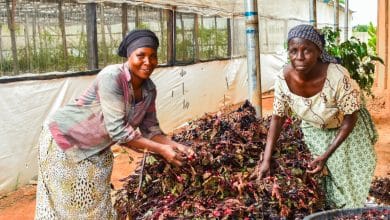
Minister Mbairobe highlighted that Socoapace is largely composed of women, aligning with the government’s objective of expanding employment opportunities for women and youth in rural areas. Support for cassava development is embedded in a broader national strategy aimed at reducing food imports and generating rural jobs.
Annual government funding allocated to the sector amounts to approximately CFA 1.5 billion, with authorities indicating that additional financial support will be extended to cooperative members in Minkoa in the near future.
The new processing unit, built on a 500-square-metre site, is equipped with semi-modern machinery to transform cassava roots into starch and flour. The facility also includes an oven for producing bakery products made from cassava flour. Initial production is being supplied to local markets, and Socoapace has already secured several orders for starch from laundry and dry-cleaning businesses in Yaoundé and surrounding areas.
During the inauguration ceremony, attendees sampled a variety of cassava-based products, including bread, brioche and biscuits made from locally processed flour. Cassava is cultivated in all ten regions of Cameroon, with annual output estimated at more than 6 million tonnes in recent years. Its derivatives – including flour, starch, chips and gari – play a crucial role in food security and the national economy.